
Bayou Land Conversations
with Landowners Cindy Martin & Ray Audas
By: Kevin Muraira
On an early February morning, my phone buzzed with a text from Ray Audas, one of Bayou Land Conservancy’s landowners. Ray manages Cindy’s Redbud Preserve, named after his wife Cindy Martin, and had good news to share: conditions were ideal for a prescribed burn that morning.
Prescribed, or controlled, burning is a land management practice with a history stretching back millennia. Indigenous peoples and land managers alike have used controlled burns to mimic natural wildfires to reduce the dead plant materials that fuel them, suppress invasive species, and stimulate native plant growth, which is why Ray began using this method himself.
The Natural Resources Conservation Service recognizes the practice for its wide-ranging ecological benefits: it reduces accumulated plant litter, enhances seed production, limits woody plant encroachment, improves wildlife habitat, and can even support wetland plant diversity. Not only does burning provide ecological and land management benefits, but it also has economic benefits. According to Ray, burning costs him 15-cents on the dollar compared to mowing his land.
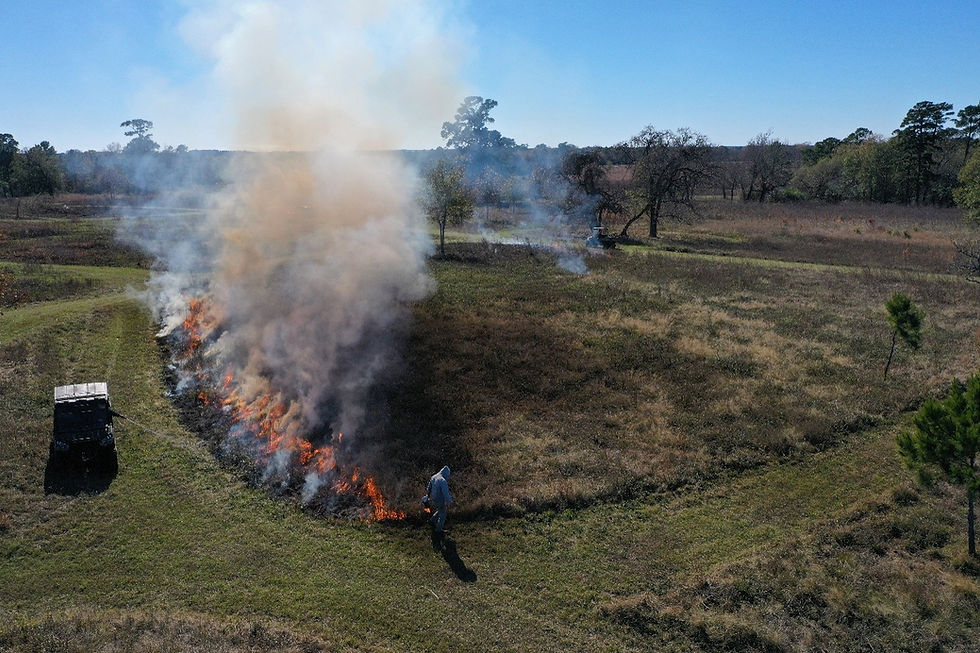
Ray approaches each burn thoughtfully, factoring in wind speed, direction, and humidity before setting the blaze. That morning, a cool 45°F degrees and gentle 5 mph westward breeze created near-perfect conditions — low enough wind to keep the fire manageable, and cool enough temperatures to prevent it from burning too intensely. I arrived to find the preserve already alight, a thick column of smoke rising into the sky. I set up the drone and got to work. On this day, Ray and his team burned an estimated 20-acres, making the total area burned since he began this method approximately 125-acres.
Ray continues to utilize this management practice each year in the winter when conditions are favorable.

I returned to the Redbud Preserve in April to follow up on the burn and see how the prairie was responding well into the Spring growing season. Upon stepping back onto the land, the prairie’s rejuvenation did not disappoint. Native plant species such as Little Bluestem, Switchgrass, Green Antelopehorn, and Prairie Plantain were already reclaiming the landscape and were emerging with vigor.

Ray has been burning his prairie for over two decades, and his careful stewardship is a big part of why BLC was eager to collaborate with him to permanently protect his land. Ray and Cindy’s commitment to responsible, long-term land management is the kind of conservation partnership that makes a lasting difference for southeast Texas prairies.
The photos tell the story better than words can. I look forward to visiting the Redbud Preserve every year as part of BLCs stewardship commitment and seeing the fruits, or in this case flowers, of Ray and Cindy’s labor.


